






What Is an API? How Apps Talk to Each Other, Explained
What is an API? An API (application programming interface) is the agreed way one app asks another app for information or to do something. In plain words, an API is a messenger between apps: your app sends a request, and the other system sends back an answer, without either one needing to see inside the other.
What does API mean, in plain words?
Think of a restaurant. You don’t walk into the kitchen to cook your own meal. You tell the waiter what you want, the waiter takes the order to the kitchen, and your food comes back to the table.
An API is that waiter. Your app is you, the customer. The other system, such as a weather service, a bank or a calendar, is the kitchen. The menu is the agreed list of things you can ask for.
How do APIs work, step by step?
- Your app asks, in the agreed way. The request follows a fixed format, like ordering from the menu.
- The API checks you’re allowed. Many APIs need a key or your permission before they answer.
- The answer comes back. Same kind of request, same kind of reply, every time.
What is an API example you’ve used today?
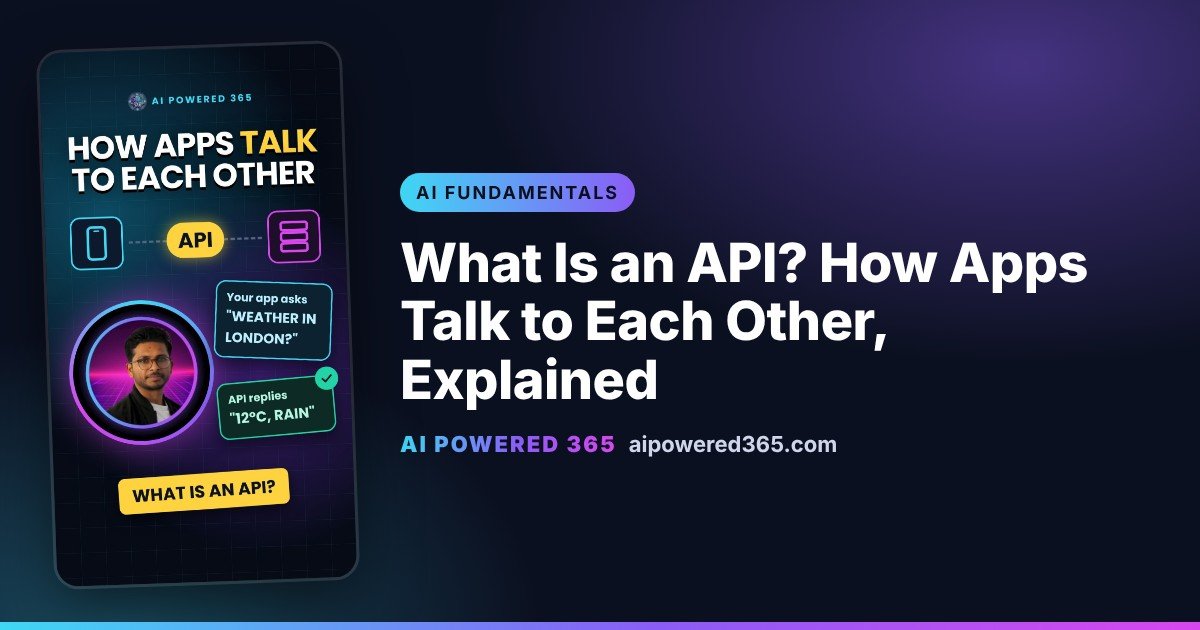
Here is an illustration. You type “London” into a weather app. The app asks a weather service’s API, “Weather for London?” The API replies, “12°C, light rain”, and the app shows it on your screen. The app doesn’t keep the weather itself. It asks for it each time.
AI assistants work the same way. When an assistant reads your calendar, checks a map or drafts an email in your inbox, there is usually an API behind the “Connect” button that lets it reach that app.
A practical tip: check before you click Connect
Before you click Connect or Allow on any app or AI tool, read what it can see and do. “See your calendar” might be fine for a scheduling tool. “Send emails as you” is a much bigger permission. Only allow what the job really needs, and remove connections you no longer use.
Related guides
- What Is an AI Agent? Chatbot vs Agent, Explained Simply
- What Is AI Bias? Why AI Copies Our Blind Spots, Explained
- What Is Overfitting? Why AI Memorises Instead of Learning
- Correlation vs Causation: Why AI Sees Patterns, Not Causes
- Watch this explainer as a YouTube Short
- The full AI Fundamentals playlist
One practical AI idea a day from AI Powered 365.
Share this content:












Post Comment