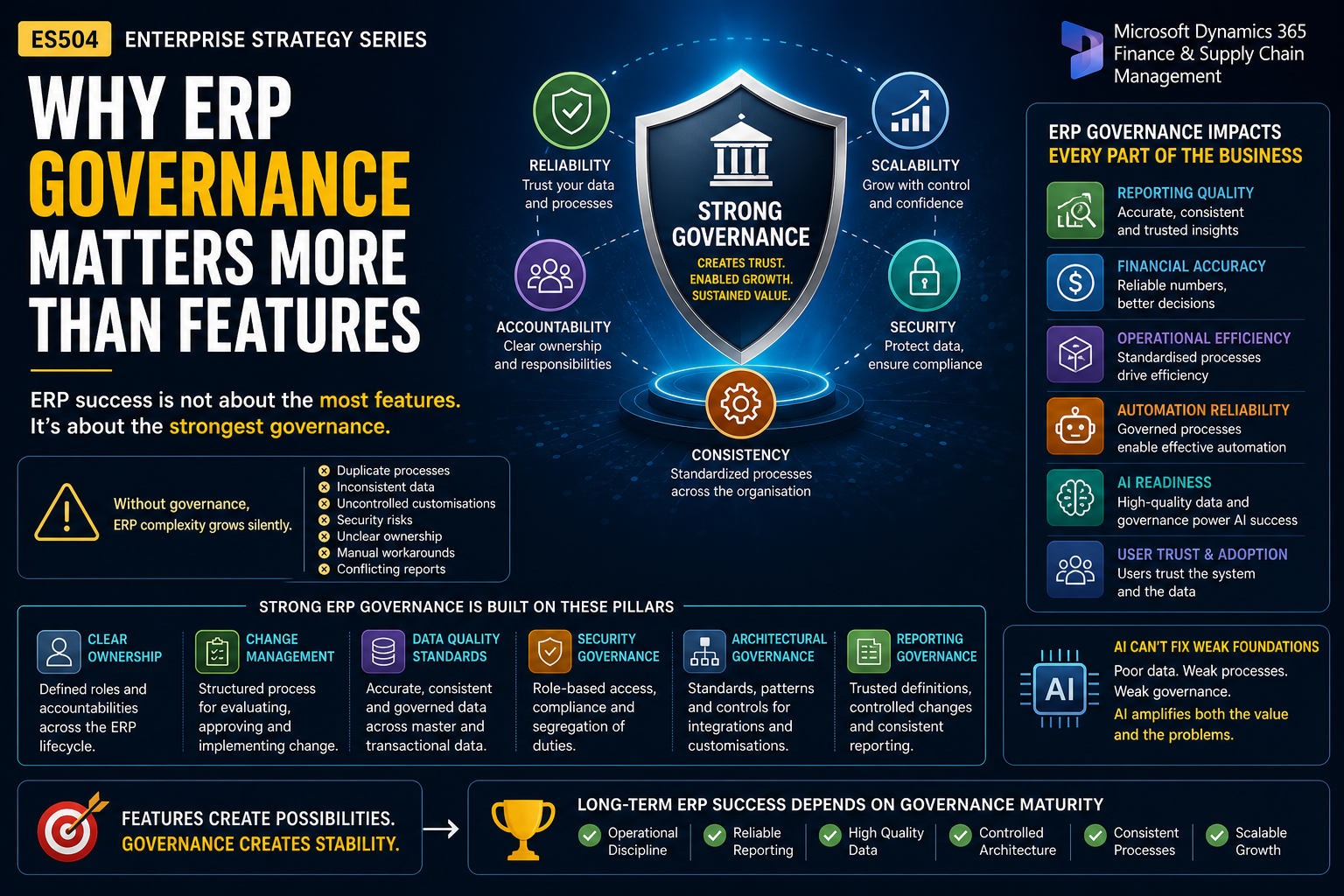
ES504 – Why ERP Governance Matters More Than Features
Many ERP transformation discussions focus heavily on features.
📌 New modules
📌 AI capabilities
📌 Automation
📌 Dashboards
📌 Integrations
📌 Copilot functionality
But in real,world ERP environments, features are rarely the biggest reason programmes struggle.
⚠️ Weak governance is.
Because even the best ERP platform can become unstable without clear operational control.
1️⃣ ERP governance is not just an IT responsibility
Many organisations mistakenly treat governance as a technical or compliance exercise.
In reality, ERP governance directly impacts:
📊 Reporting quality
💰 Financial accuracy
📦 Operational efficiency
🔐 Security posture
🤖 Automation reliability
🧠 AI readiness
👥 User trust
📈 Scalability
Governance is what keeps the platform reliable as the business grows.
2️⃣ Without governance, ERP complexity grows rapidly
ERP platforms naturally evolve over time.
New requirements appear constantly:
📌 Business changes
📌 Regulatory updates
📌 Acquisitions
📌 New integrations
📌 Localisation requirements
📌 Reporting demands
📌 AI initiatives
Without strong governance, organisations slowly accumulate:
⚠️ Duplicate processes
⚠️ Inconsistent master data
⚠️ Uncontrolled customisations
⚠️ Poor security practices
⚠️ Conflicting reports
⚠️ Manual workarounds
⚠️ Unclear ownership
And eventually, the ERP platform becomes harder to trust and harder to scale.
3️⃣ Governance creates operational consistency
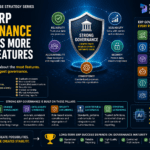
Strong ERP governance is not about slowing people down.
It is about creating consistency across the organisation.
That includes:
🔹 Clear ownership models
🔹 Defined approval processes
🔹 Standardised business rules
🔹 Controlled change management
🔹 Security governance
🔹 Data quality standards
🔹 Architectural decision,making
The goal is not bureaucracy.
The goal is operational stability.
4️⃣ AI makes ERP governance even more important
Many organisations are excited about AI,powered ERP capabilities.
But AI depends heavily on:
📊 Reliable data
🔐 Strong security
🔗 Consistent processes
📁 Trusted reporting
🏗️ Stable architecture
If governance is weak, AI outcomes become unreliable.
⚠️ Poor data produces poor AI decisions.
⚠️ Weak controls create security risks.
⚠️ Inconsistent processes reduce automation quality.
AI cannot compensate for governance gaps.
It exposes them faster.
5️⃣ Strong governance enables long,term ERP success
The most successful ERP environments are not necessarily the ones with the most features.
They are the ones with:
✅ Strong operational discipline
✅ Clear ownership
✅ Reliable reporting
✅ Controlled architecture
✅ Consistent processes
✅ High,quality data
✅ Long,term decision,making
This is especially important for platforms like Microsoft Dynamics 365 Finance & Supply Chain Management where the ecosystem continuously evolves through:
- AI innovation
- automation
- integrations
- security changes
- platform updates
- business expansion
🚀 The organisations extracting the most value from ERP understand this clearly:
Features create possibilities.
But governance creates stability, trust, and scalability.
And in modern ERP environments, long,term success depends far more on governance maturity than feature count.
#ERP #Dynamics365 #ERPGovernance #EnterpriseArchitecture #ERPStrategy #DigitalTransformation #AI #Microsoft #TechnologyLeadership #BusinessTransformation
Share this content:










Post Comment