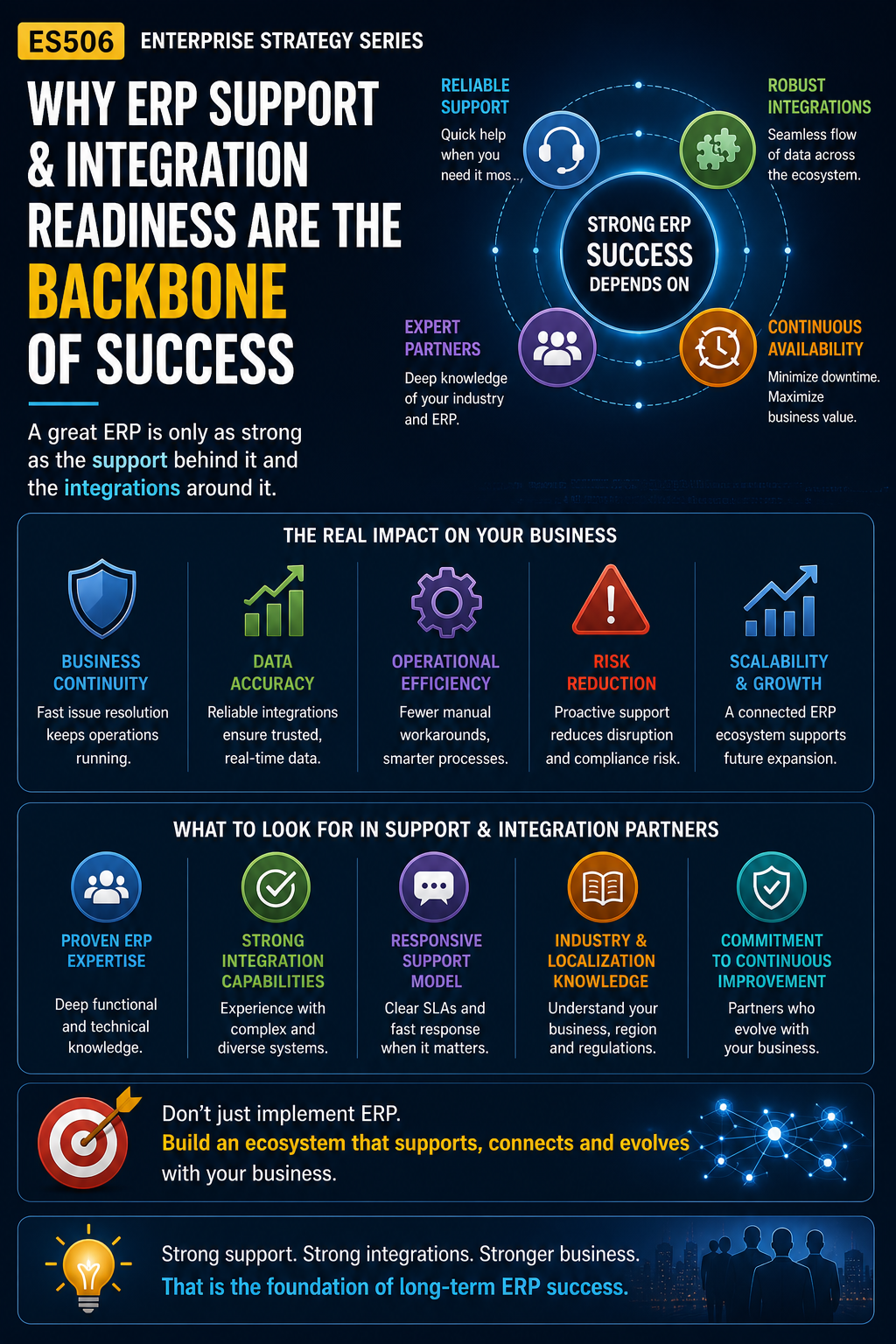
ES506 – Why ERP Support Models Matter More Than Organisations Realise
Many ERP programmes focus heavily on implementation.
But long,term success is often determined after go,live by something much less visible:
⚠️ The support model.
Because even the best ERP architecture can struggle without strong operational support structures.
1️⃣ ERP support is not just about fixing incidents
Many organisations still view ERP support as:
📌 Ticket management
📌 User support
📌 Issue resolution
But modern ERP support responsibilities are much broader.
Strong ERP support enables:
🔹 Operational continuity
🔹 Integration monitoring
🔹 Financial stability
🔹 Security oversight
🔹 Regulatory responsiveness
🔹 Reporting reliability
🔹 Continuous improvement
ERP platforms now operate as critical enterprise infrastructure.
2️⃣ Integration support has become business,critical
Modern ERP ecosystems rely heavily on integrations:
🔗 APIs
🔗 Automation platforms
🔗 External vendors
🔗 Logistics systems
🔗 E,invoicing platforms
🔗 Reporting tools
🔗 AI services
When integrations fail, operational impact can spread rapidly across the business.
This is why organisations increasingly require:
✅ Monitoring
✅ Alerting
✅ Escalation processes
✅ Clear ownership
✅ Support coverage
Not just technical deployment.
3️⃣ ERP support requires operational understanding — not just technical skills
The strongest ERP support teams understand both:
💻 Technology
AND
🏢 Business operations
Because ERP incidents often impact:
📦 Warehouses
💰 Finance teams
🧾 Compliance reporting
🚚 Customer deliveries
📊 Executive reporting
Support teams must understand operational consequences — not only system behaviour.
4️⃣ Availability matters during critical operational periods
ERP environments experience peak operational pressure during:
📌 Month,end close
📌 Financial reporting
📌 Regulatory submissions
📌 Switchover activities
📌 High,volume operational periods
This is where strong support coordination becomes extremely important.
Successful ERP organisations ensure:
✅ Clear escalation paths
✅ Defined ownership
✅ Business,aligned support coverage
✅ Fast communication channels
Because operational downtime in ERP environments quickly becomes business downtime.
🚀 The organisations succeeding long,term understand this clearly:
ERP success is not only defined by implementation quality.
It is also defined by:
🔹 Support maturity
🔹 Operational responsiveness
🔹 Integration stability
🔹 Continuous improvement capability
Modern ERP platforms require long-term operational partnership , not just project delivery.
#ERP #Dynamics365 #ERPStrategy #EnterpriseArchitecture #DigitalTransformation #TechnologyLeadership #ERPTransformation #Microsoft #BusinessTransformation #ERPIntegration
Share this content:









Post Comment