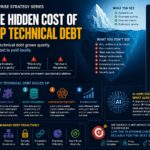
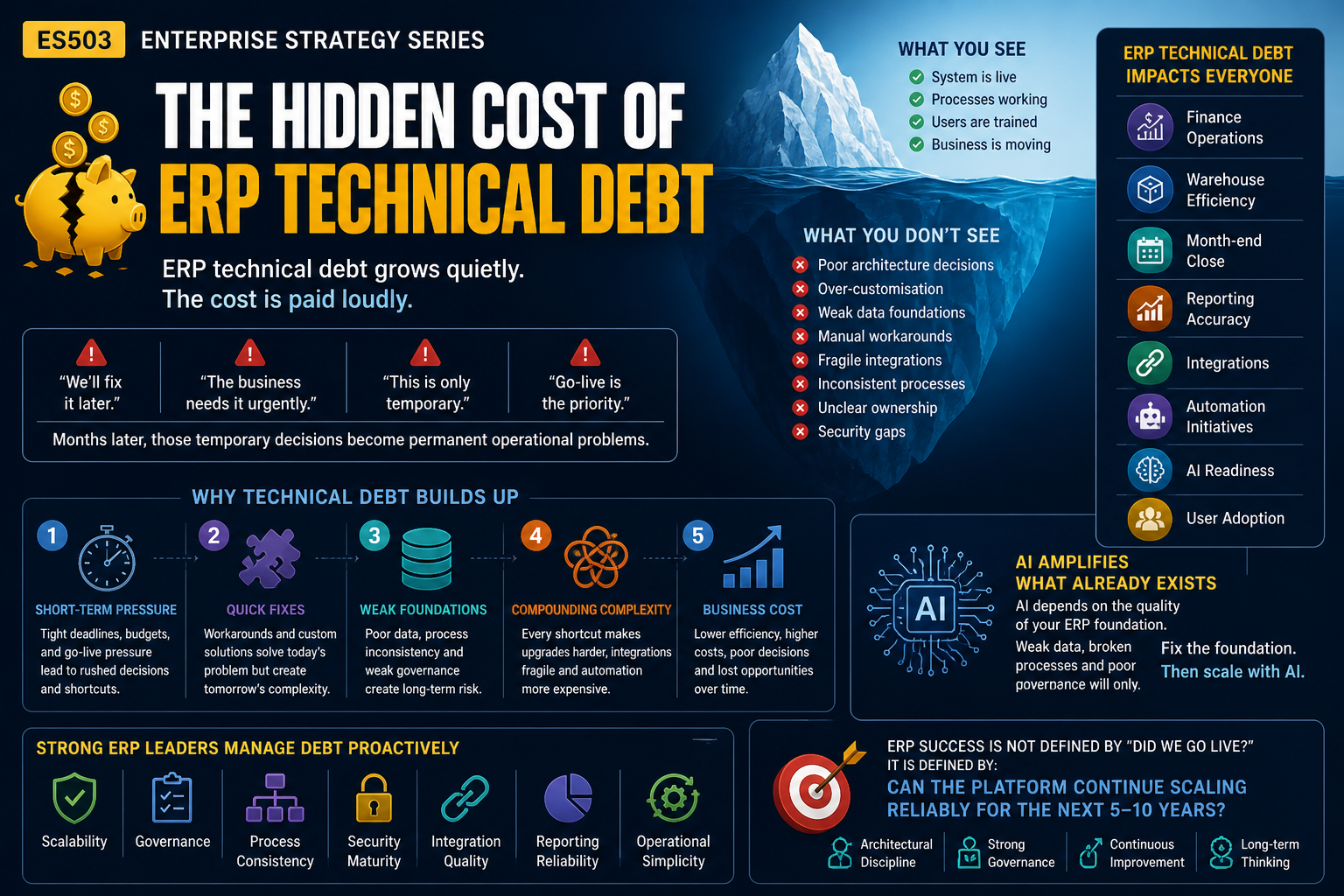
ES503 – The Hidden Cost of ERP Technical Debt
Most organisations recognise financial debt immediately.
Very few recognise ERP technical debt until it starts damaging operations.
And by then, the cost is already spreading across the business.
Technical debt in ERP rarely appears as one major disaster.
Instead, it grows quietly through hundreds of “small” decisions made under pressure.
⚠️ “We’ll fix it later.”
⚠️ “The business needs it urgently.”
⚠️ “This is only temporary.”
⚠️ “Go,live is the priority.”
Months later, those temporary decisions become permanent operational problems.
1️⃣ ERP technical debt is not just a technical problem
Many people assume technical debt only impacts IT teams.
In reality, ERP technical debt affects:
📉 Finance operations
📦 Warehouse efficiency
⏳ Month,end close
📊 Reporting accuracy
🔗 Integrations
🤖 Automation initiatives
🧠 AI readiness
👥 User adoption
The business eventually pays for every shortcut.
2️⃣ The most dangerous ERP technical debt is often invisible
Some technical debt is obvious.
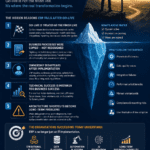
But the most damaging problems are usually hidden inside:
⚠️ Poor master data structures
⚠️ Inconsistent business processes
⚠️ Weak security governance
⚠️ Over,customisation
⚠️ Duplicate integrations
⚠️ Unclear ownership
⚠️ Manual workarounds
⚠️ Poor reporting foundations
These issues slowly reduce trust in the platform.
And once users stop trusting ERP data, operational behaviour starts breaking down.
3️⃣ Short,term delivery pressure creates long,term complexity
ERP programmes often operate under intense pressure:
📌 Tight deadlines
📌 Budget constraints
📌 Go,live pressure
📌 Regulatory requirements
📌 Operational urgency
Under pressure, organisations naturally optimise for speed.
But speed without architectural discipline creates future instability.
The problem is:
🚫 Technical debt compounds over time.
Every rushed workaround makes future:
- upgrades harder
- automation slower
- AI initiatives riskier
- integrations more fragile
- reporting less reliable
4️⃣ AI will expose weak ERP foundations faster than ever
Many organisations are rushing toward AI adoption.
But AI depends heavily on ERP quality.
If the ERP platform contains:
⚠️ Inconsistent master data
⚠️ Broken processes
⚠️ Poor governance
⚠️ Unreliable reporting
⚠️ Fragmented integrations
…then AI simply amplifies the confusion.
This is why ERP architecture is no longer just an IT concern.
It is becoming a strategic business capability.
5️⃣ Strong ERP leadership manages technical debt proactively
The best ERP leaders do not ignore technical debt.
They continuously evaluate:
🔹 Scalability
🔹 Governance
🔹 Process consistency
🔹 Security maturity
🔹 Integration quality
🔹 Reporting reliability
🔹 Operational simplicity
Because modern ERP platforms are never static.
They continuously evolve with:
📈 Business growth
🌍 Localisation changes
🏢 Acquisitions
🤖 AI capabilities
⚡ Automation opportunities
🔐 Security risks
🚀 The organisations succeeding long,term understand this clearly:
ERP success is not defined by:
❌ “Did we go live?”
It is defined by:
✅ “Can the platform continue scaling reliably for the next 5–10 years?”
That requires:
- architectural discipline
- strong governance
- continuous improvement
- long,term thinking
Because every ERP shortcut eventually becomes a business cost.
#ERP #Dynamics365 #EnterpriseArchitecture #ERPStrategy #TechnicalDebt #DigitalTransformation #AI #Microsoft #TechnologyLeadership #BusinessTransformation
Share this content:









Post Comment