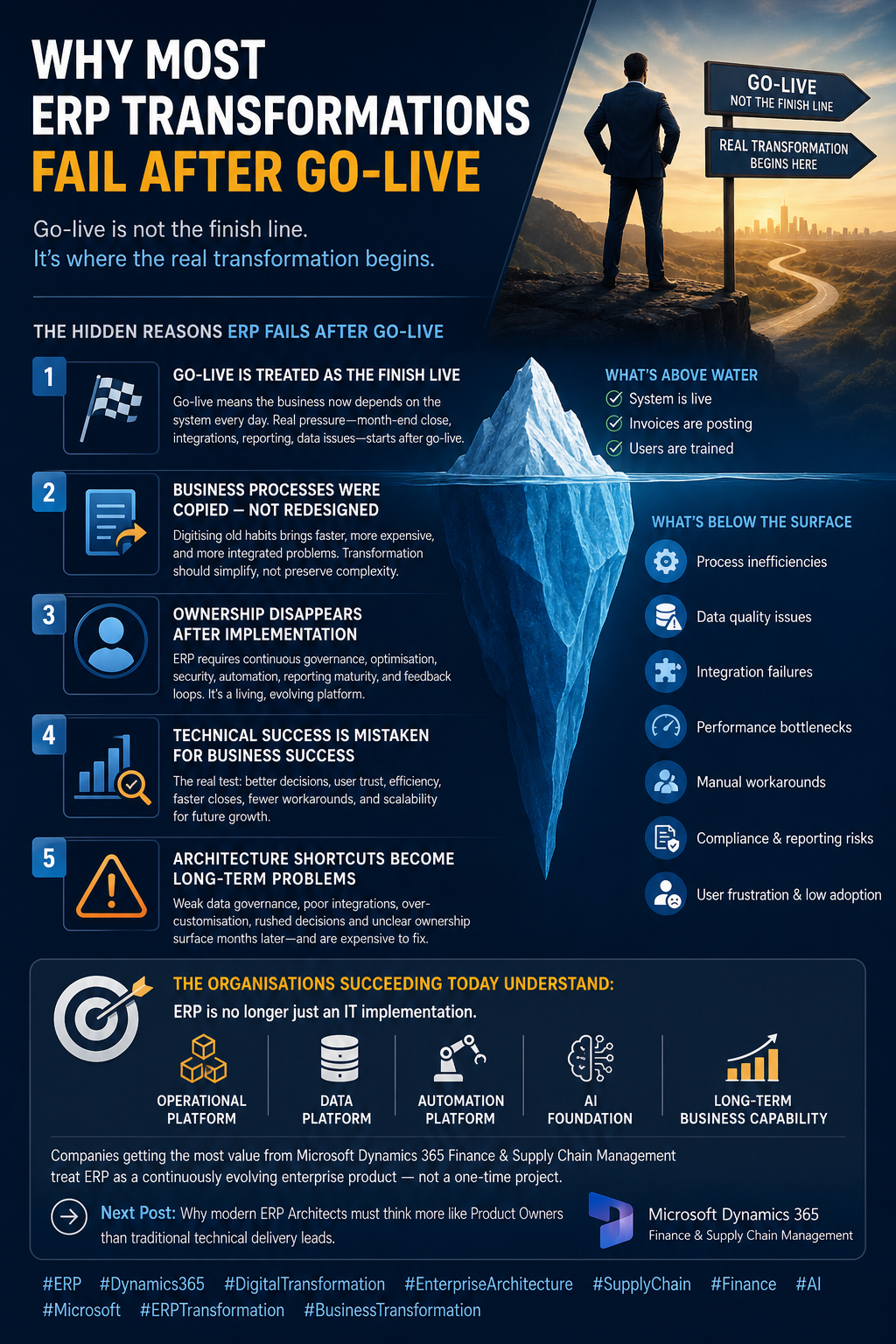
ES501 – Why Most ERP Transformations Fail After Go-Live
Most ERP transformation programmes don’t collapse during implementation.
They slowly fail after go-live, when the business starts depending on them under real operational pressure.
✅ The project team celebrates
✅ The system is live
✅ Invoices are posting
✅ Users are trained
✅ Leadership believes the transformation is complete
But in reality, the hardest phase has just started.
After working across large-scale ERP programmes covering finance, supply chain, localisation, integrations, ISVs, compliance, and AI-driven transformation initiatives, I’ve seen the same pattern repeatedly:
⚠️ Most organisations treat ERP as a project.
⚠️ Very few treat it as an operational product.
That mindset difference changes everything.
1️⃣ Go-live is treated as the finish line
Go-live is not success.
It simply means the organisation is now depending on the platform every single day.
The real test begins when operational pressure hits:
📌 Month-end close
📌 Warehouse operations
📌 Customer escalations
📌 VAT and statutory reporting
📌 Integrations failing
📌 Data quality gaps
📌 Performance bottlenecks
📌 Unexpected business scenarios
This is where platforms like Microsoft Dynamics 365 Finance & Supply Chain Management are truly tested.
2️⃣ Old processes are copied instead of redesigned
Many ERP programmes digitise legacy habits rather than improve outcomes.
When inefficient processes move into a modern ERP platform, organisations simply get:
❌ Faster problems
❌ More expensive problems
❌ More integrated problems
Transformation should simplify operations, not preserve complexity.
3️⃣ Ownership disappears after implementation
One of the biggest mistakes organisations make is assuming ERP ownership ends after deployment.
Successful ERP platforms require continuous:
🔹 Governance
🔹 Optimisation
🔹 Architectural reviews
🔹 Security improvements
🔹 Automation opportunities
🔹 Reporting maturity
🔹 Operational feedback loops
ERP is no longer static technology.
Especially in the era of:
🤖 AI
⚡ Automation
🧠 Copilot
🔗 Connected enterprise platforms
4️⃣ Technical success is mistaken for business success
A system can be technically successful while operationally failing.
The real questions are:
✔️ Is finance closing faster?
✔️ Are warehouse teams operating more efficiently?
✔️ Do users trust the data?
✔️ Are leaders making better decisions?
✔️ Are manual workarounds reducing?
✔️ Is the platform scalable for future growth and acquisitions?
If those outcomes are not improving, the transformation is incomplete.
5️⃣ Short-term architecture decisions become long-term pain
Under delivery pressure, shortcuts get taken:
⚠️ Weak master data governance
⚠️ Rushed localisation decisions
⚠️ Poor integration design
⚠️ Inconsistent reporting structures
⚠️ Over-customisation
⚠️ Unclear ownership
⚠️ Weak security governance
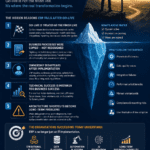
These issues rarely appear immediately at go-live.
They surface months later, when fixing them becomes significantly harder and more expensive.
🚀 The organisations succeeding today understand one thing clearly:
ERP is no longer just an IT implementation.
It is:
🔹 An operational platform
🔹 A data platform
🔹 An automation platform
🔹 An AI foundation
🔹 A continuous improvement capability
🔹 A long-term business asset
The companies extracting the most value from Microsoft Dynamics 365 Finance & Supply Chain Management are the ones treating ERP as a continuously evolving enterprise product, not a one-time project.
In my next post, I’ll explain why modern ERP Architects must evolve beyond technical delivery, and start thinking more like Product Owners responsible for long-term business value.
#ERP #Dynamics365 #ERPTransformation #EnterpriseArchitecture #ERPStrategy #DigitalTransformation #AI #Microsoft #TechnologyLeadership #BusinessTransformation
Share this content:









Post Comment